In November, major business newspapers and news outlets discussed the question of whether we are in a bubble in the field of artificial intelligence. The valuations of the large technology companies were examined more closely than usual. In particular, the concentration of the big tech firms in the various indices plays an important role if we really are in a bubble and it eventually loses air.
🤓 The P/E ratio (price-to-earnings ratio) is a measure that shows how much investors are willing to pay for one dollar of a company’s annual earnings.
The “normal” trailing P/E ratio of the S&P 500 is currently around 27-28.
Looking at the trailing P/E over roughly the past 5 years, the average level is approximately 23–25.
Over the past 10 years (2015–2025), the trailing P/E has averaged roughly 22–23.
What does that mean?
The market is clearly more expensive than its own 5- and 10-year averages.
So prices have risen faster than earnings. Investors are currently paying a high price for every dollar of corporate profit. Historically, high P/E ratios tend to be associated with lower forward returns over the next 5–10 years.
High valuation does not mean an imminent correction — but it increases risk.
Important points:
High ≠ crash tomorrow. But high = elevated structural risk.
Markets can remain overvalued for years if liquidity, narratives, and momentum remain strong. Overvaluations usually unwind only when a trigger appears (earnings decline, recession, rate shock, geopolitical risk, etc.).
For long-term investors: no panic — but realism.
Historically, even expensive markets can generate good long-term returns if earnings grow strongly. But entering the market at very high valuations usually results in subdued returns in the early years.
Bottom Line
The S&P 500 is clearly at a high valuation today. Not necessarily a bubble — but a phase where future returns are likely to be moderate and the probability of significant drawdowns is above average.
Important: The movements of the S&P 500 affects the whole business world.
What to do with the Gondinero Index?
The problem with bonds is that they, too, can be very volatile nowadays, unlike in the past. Therefore, I decided to move fully back into equities, because the return potential is higher than with bonds. However, I want to minimize risk within the equity space, and in November I spent a lot of time thinking about this and running through different scenarios.
The main driver is that I change from a mainly growth based strategy to a value based strategy.
1.) The high valuation of the large technology companies worries me a bit, which is why I switched my S&P 500 position to an equal-weighted S&P 500.
This means that all companies in this important index have the same weight in its value.
Nearly 40% of the S&P 500’s performance depends actually on just ten firms — primarily large technology and growth companies. If even one or two of these companies experience a setback (earnings miss, regulation, technological disruption), the entire index can be affected.
Thus the change in order to reduce risk.
2.) I sold the bond ETF.
3.) In order to broaden the regional aspect I sold the developed markets ETF as well as the euro stoxx ETF and bought an emerging markets ETF with the focus on value as well as an all world ETF in order to not neglect the growth aspect.
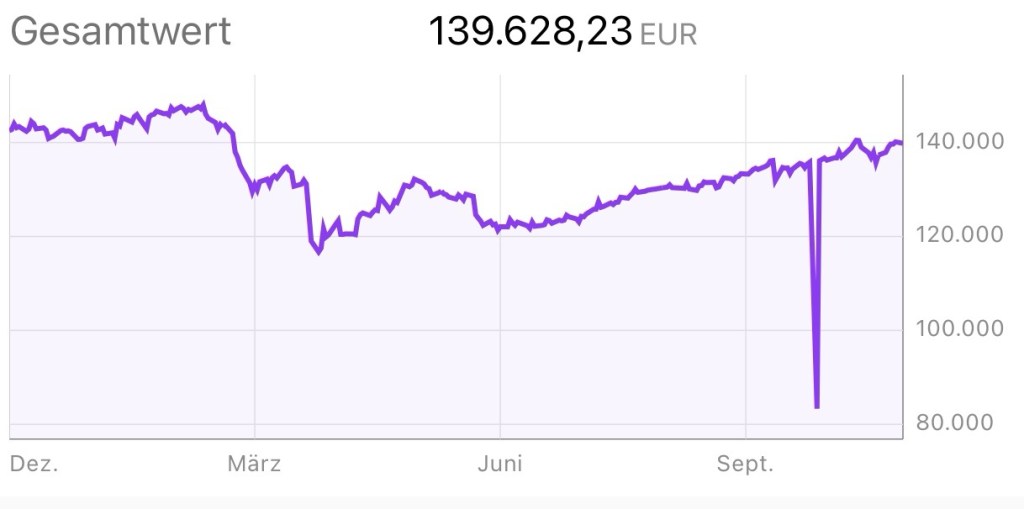
The new Gondinero Index:

Why did I choose this?
1.) Very strong regional diversification
I have exposure to:
• United States (both cap-weight and equal-weight)
• Europe
• Emerging Markets
• Global markets via FTSE All-World
No single region dominates excessively, especially because of my 20% equal-weight rule.
2.) Balanced factor exposure (especially Value)
Both:
• MSCI EM Value
• MSCI Europe Value
give a systematic value tilt, historically associated with:
• Higher expected returns
• Lower downside relative to growth during expensive markets
This also reduces the overweight to mega-cap tech I would get from a pure S&P 500 cap-weighted allocation.
3.) S&P 500 Equal Weight = diversification within the US
This removes the concentration in the “Magnificent 7” and is historically:
• More volatile
• But often higher performing over long windows
• More correlated with economic breadth rather than mega-cap narratives
This fits well with my interest in long-term return drivers, not short-term hype cycles.
4.) Berkshire Hathaway = a high-quality anchor
Berkshire acts like:
• A diversified conglomerate
• Part-value ETF, part-active manager
• With extremely strong capital allocation discipline
It behaves differently from broad ETFs and adds a quality + cash-flow stability factor.
Verdict
After analyzing through several AI tools this portfolio is suggested as unusually well-balanced and extremely resilient for long-term wealth building.
Pros
• Extremely diversified
• Balanced factor exposure (value + equal weight + quality)
• Not dependent on US tech valuations
• Good long-term risk-adjusted profile
• Berkshire adds unique high-quality exposure
Cons
• Will underperform during US mega-cap dominance
• Europe value is structurally slow-growing
I take the cons and don’t bother high valuations of big tech any longer.
I wish you a nice time until the years change. And if you have questions, put them in the comment section. Maybe I’ll answer them 😎
 Gondinero Index Financial Education (by Jörg Jorge George Giorgio 🤗)
Leave a comment